Most irrigation repairs in this metro get called in one symptom at a time, months after the thing that caused them. The spring startup is the opposite approach: one pass, in March, that finds what the winter did before the first hot week makes it urgent — and that, in practice, is where cracked backflow assemblies get discovered while there is still time to schedule the replacement calmly.
The single most-skipped step and the one that causes the most damage. A mainline that has been drained refills at high velocity through an empty pipe, and snapping the isolation valve open sends a slug of water into the system hard enough to break fittings and blow heads off risers. The valve gets opened part way, the system fills, then it opens fully. That is thirty seconds of patience against a possible manifold repair.
Before any zone runs. A hairline crack in a bonnet or body shows itself the moment pressure is applied, and it is far better to find it standing next to it than to find it from a bill six weeks later. Winter damage lives here more than anywhere else on the system.
Each station run individually, long enough for the heads to seat and the pattern to settle: arcs, seals, nozzles, heads out of grade, dry corners, fogging, weeping valves, wet patches that should not be there. A zone glanced at for ten seconds is a zone not checked.
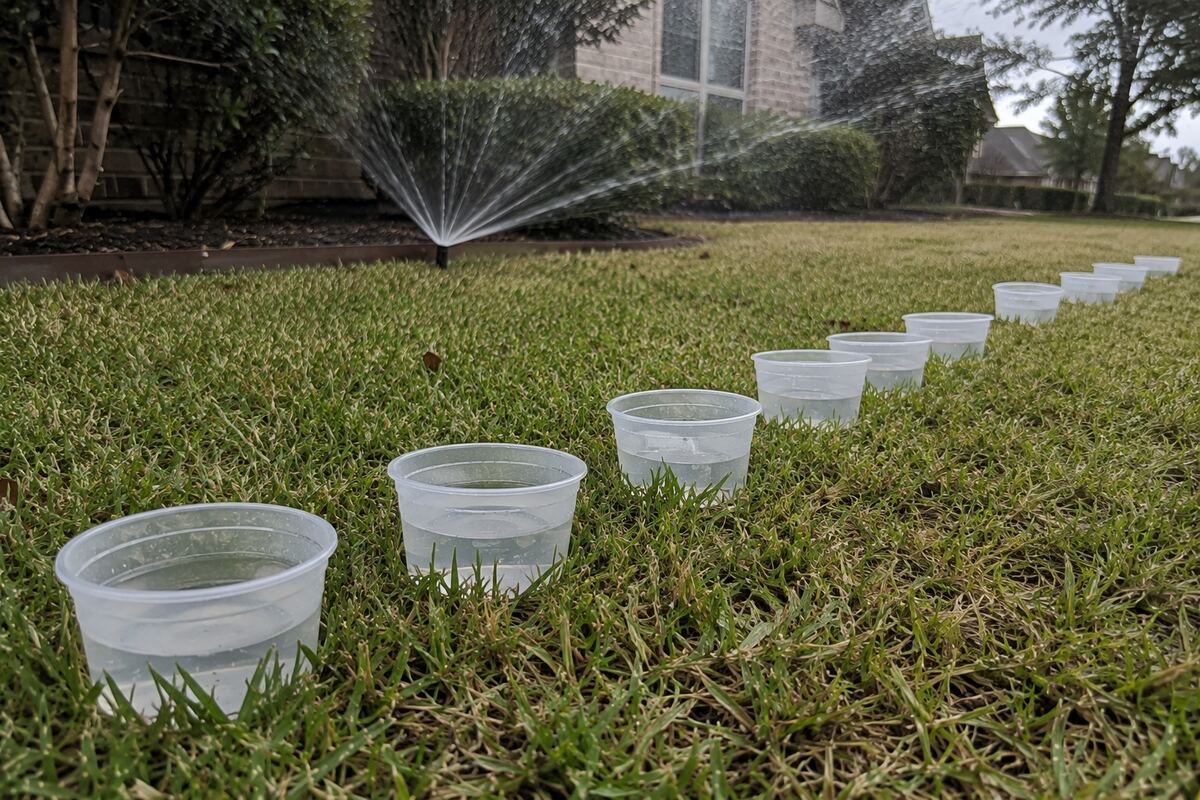
A startup finds broken things. An audit answers a different question — whether the system, in good repair, actually applies water evenly. The method is unglamorous and unbeatable: identical containers set out in a grid across a zone, the zone run for a fixed time, then the depth in each container compared.
What it exposes is usually invisible from the driveway. A zone where the far end collects half what the near end does has a pressure loss problem, not a nozzle problem. A zone with one dry pocket between three healthy heads has a spacing problem that no amount of extra run time fixes — it just drowns the wet parts to keep the dry part alive, which is exactly the pattern behind a lot of large Houston summer bills.
The audit also produces the one number worth having: how many minutes this zone needs to apply a given depth of water. Without it, run times are guesses, and a guess that is thirty per cent high runs every night, all summer.
March is the window because winter damage has happened and the demand season has not started. A cracked backflow assembly found in March is a scheduled job at an ordinary price. The same assembly found in the last week of May, when every irrigator in the metro is booked, is the same part and a considerably worse week.
There is a second, less obvious reason. Spring is when the ground is finishing a season of movement — heads that have been pushed out of grade over the winter show it now, and resetting them in March means a summer of correct coverage rather than a summer of brown patches nobody could explain. That is a specifically local reason for a specifically local timing.
That is genuinely the case where it pays best, because the faults it finds are the invisible ones — a weeping valve, a zone running thirty per cent longer than it needs, a backflow bonnet with a crack that has not started leaking yet. On a system with an obvious fault, a repair call is the right thing to book and the audit can wait.
The mechanical parts, yes, and doing so is a genuinely good idea: open the isolation valve slowly, run each zone from the controller, and walk the yard while each one runs with a notepad. That alone catches most of what matters. Where it hands over is at the measurement — pressure at the head, distribution uniformity, and whether a system is over- or under-applying — and at the point where Texas treats inspecting an irrigation system as licensed work when someone is doing it for a customer.
The startup walk is annual. A full measured audit is worth doing when a system is first taken over by a new owner, after any significant work in the yard, when the water bill has changed shape, or every few years as a baseline. It is not an annual purchase.
Ask for it in priority order and in writing: what is leaking now, what is wasting water now, and what is simply not ideal. Those are three different budgets, and a list that does not separate them is not much use. Anything on it can be scheduled across a season rather than all at once.
What to look at after a hard freeze, before the spring startup.
The part the startup is really checking, and what its leaks mean.
Arcs, nozzles and grade — what the walk usually turns up.
Startup and audit against the repairs they tend to prevent.
Say how many zones the system has and where in the metro the property is. A startup is short, scheduled work — it is the freeze damage it finds that is worth the calendar space.
Call (346) 605-8787 Describe the Problem Houston