Every irrigation system has two kinds of pipe and they behave completely differently when one of them fails. The mainline runs from the backflow assembly to the valves and holds pressure permanently. The laterals run from each valve out to that zone’s heads and are only pressurized while the zone is running. Working out which one has broken is the first question, and the symptom answers it.
A patch that stays saturated with the controller switched off is a mainline break by definition, because nothing else on the system holds water when no zone is scheduled. This is the urgent case: the meter is running continuously and the first action is closing the irrigation isolation valve, not diagnosing anything.
A break on a lateral only leaks during that zone’s run time, so the ground dries between cycles and the symptom appears intermittent. The other tell is that the heads beyond the break lift weakly or not at all, because the water is escaping before it reaches them. Not urgent, but it wastes a lot of water quietly.
A third pattern — a fine spray of soil, gravel or mulch thrown up out of the turf while a zone runs — is a lateral break close enough to the surface to blow through. It is the easiest kind to find and the most alarming to watch.
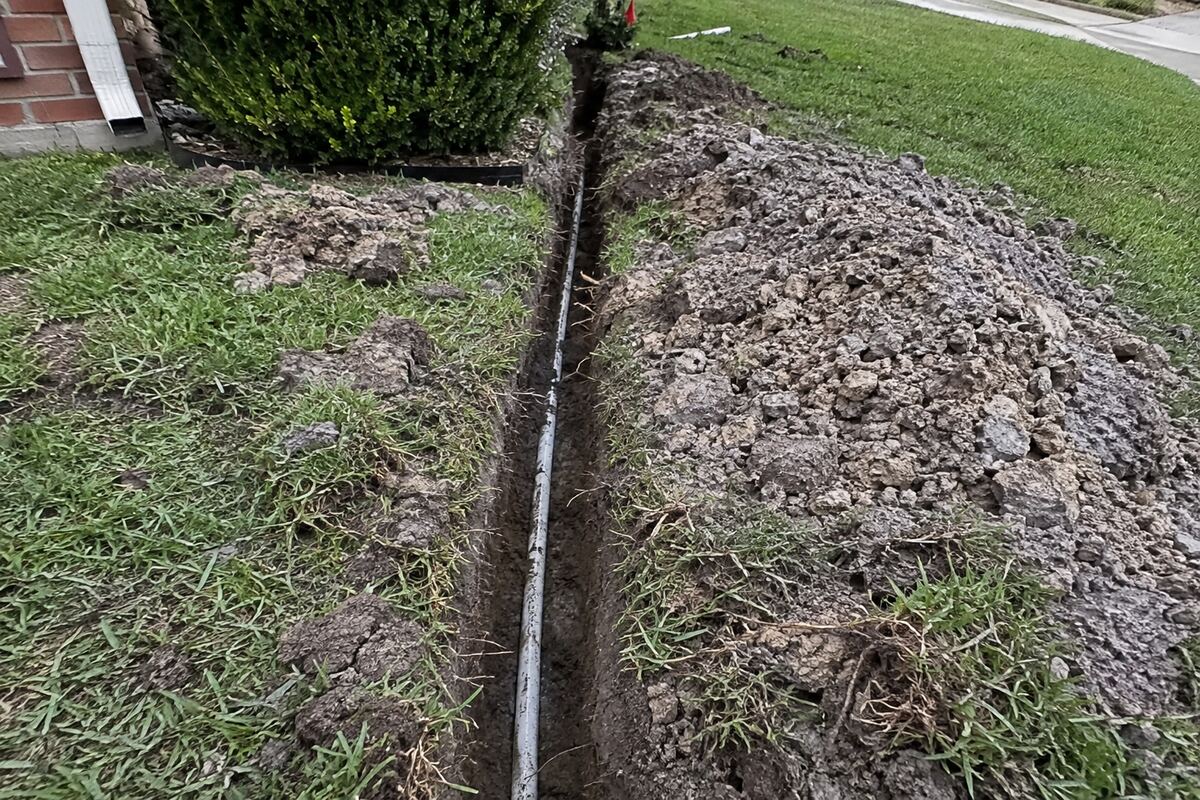
Clay makes this harder than it sounds. Water does not soak straight up through Beaumont clay; it runs along the sand bedding and the disturbed backfill of the original trench, which means it surfaces wherever the trench happens to be shallowest — frequently many feet from the actual break, sometimes at a driveway edge, sometimes into a storm drain where it never surfaces at all. Digging at the wet spot is a reasonable first guess and a poor assumption.
Running each zone in turn and watching pressure and head behavior brackets the break to one lateral and often to one run between two heads. Where the pipe route is unknown — which is most twenty-year-old systems, since as-built drawings almost never survive — a wire tracer or an acoustic listening device on a pressurized line does the rest. The point of all of it is to open one small hole rather than a trench.
Systems installed across this metro over the last thirty years use PVC for mainline and laterals, with poly used for swing joints and some lateral work. What actually varies is depth and workmanship: pipe laid shallow to save time is the pipe that gets cut by an edger, a fence post or an aerator later, and it is also the pipe most exposed in a freeze. Depth is not something anyone can see from above, and it explains a lot of otherwise puzzling repeat failures.
A PVC repair means cutting out the damaged section and joining new pipe with either solvent-welded couplings or a slip-fix repair coupling that telescopes to close the gap without having to spring the pipe. Both are ordinary work. The constraint that surprises people is cure time: solvent weld needs a genuinely dry joint and needs to set before pressure returns, and a trench in Houston clay after rain is not a dry environment. That is why a repair booked on a wet afternoon sometimes gets pressure-tested the following morning rather than the same hour, and why an irrigator who insists on that is doing it properly rather than stretching the job.
On a mainline the same work carries more consequence, because the joint will sit under continuous pressure for its whole life rather than for twenty minutes a day. Mainline repairs are where the difference between a good fitting and an adequate one shows up, five years later.
Almost certainly. A severed lateral, a cut zone wire or both is the standard outcome of any trenching, post-setting or excavation across an unmarked irrigation system, and it is common enough to have its own section on this site. Utility locating services mark public utilities; private irrigation lines are not on that list and are not marked by anyone unless the homeowner arranges it.
There are clamp-style repair fittings that wrap a damaged pipe, and they have a place on a temporary basis or where a joint cannot be reached. On buried PVC that will be reburied and forgotten, cutting out the damage and putting in new pipe is what lasts. A clamp under two feet of clay is a future call-out.
Deep enough to be below routine cultivation and mowing, and deeper for mainline than for laterals. Rather than quote a figure that varies by jurisdiction and by pipe function, the useful question to ask on any repair is what depth the existing pipe was found at — because shallow pipe is the root cause of a large share of repeat damage, and a repair is the one moment when a shallow run can be reset without extra excavation.
A hand-dug repair trench in St Augustine knits back over a growing season if the sod is lifted in pieces and put back rather than mixed into the spoil. Trenching across a yard in July with the turf discarded is a different outcome. It is worth agreeing before the work which of those is happening.
Where the shutoff is, before anything gets diagnosed.
The most common single cause of a severed lateral in this metro.
Proving from the meter that the pipe is where the water is going.
The thing that fatigues fittings until one of them lets go.
If it stays wet with the controller off, close the isolation valve first. Then say which zone, where the water shows, and what part of Houston the property is in.
Call (346) 605-8787 Describe the Problem Houston