Every other zone runs. This one gets its turn in the cycle, the controller says it is on, and nothing happens at the heads. That is a good symptom to have, because it narrows the problem to three things and one of them can be ruled out in about ninety seconds without any tools at all.
A zone valve has a bleed screw or a solenoid that can be turned a quarter-turn counter-clockwise to let pressure off the diaphragm manually. Lift the lid on the valve box for that zone and try it.
The valve and the pipe downstream of it are fine. The fault is electrical — the 24-volt signal is not reaching the solenoid, or the solenoid coil is open. That is a solenoid, a splice or a controller output, and it is the cheaper of the two branches.
The valve itself is not opening: debris under the diaphragm, a torn diaphragm, a seized plunger, or no water reaching the valve at all because an isolation valve upstream got closed. This branch means the box gets opened properly.
Nothing about that test needs a license, a meter or a shovel, and it is worth doing before making the call — it turns “a zone is broken” into a sentence a licensed irrigator can act on before the truck leaves.
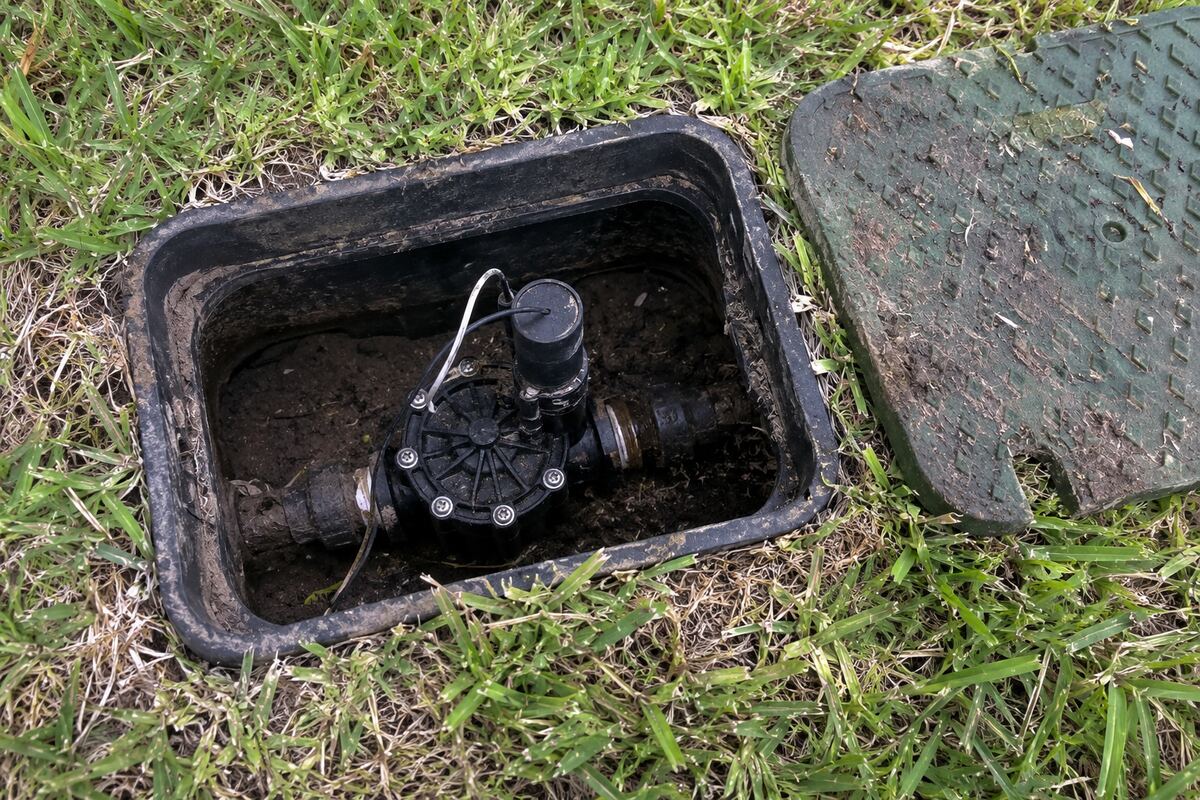
The solenoid is a coil. It reads as a resistance across its two leads — a healthy one typically lands somewhere in the twenty-to-sixty ohm range, an open coil reads infinite, and a shorted one reads near zero and will often take the controller’s output with it. A licensed irrigator will read the coil at the valve and the voltage at the controller terminal, in that order, because the two readings together say whether the break is in the coil or somewhere in the fifty to two hundred feet of buried wire between them.
Field splices sit underground and stay wet. A twist-on connector meant for a dry junction box corrodes through in a couple of Houston seasons; the gel-filled or grease-cap connectors made for direct burial do not. A large share of “dead zone” calls end at one green, crumbling splice inside a valve box.
One shared common wire returns from every valve to the controller. Cut that one — a fence post, an edger, a landscape auger — and the whole system goes silent at once while the controller keeps counting down happily. A single dead zone is a zone wire; all zones dead is the common or the transformer.
A diaphragm valve holds itself shut using the system’s own pressure. Grit that got into the mainline during an earlier repair, a sun-hardened diaphragm on a twenty-year-old valve, or a spring that has lost its temper all produce the same result. Most residential valves take a rebuild kit — diaphragm, spring, solenoid — for a fraction of the cost of replacing the body, and the body is usually the part worth keeping because pulling it out means cutting into the manifold.
The one case where the whole valve comes out is a cracked body or bonnet, which in this metro most often means a freeze got to a valve sitting too shallow in a box that had filled with water. That is the same failure mechanism the freeze pages cover on the backflow assembly, one step further down the system.
On the physical level it is a screw-off, screw-on part with two wire leads, and plenty of homeowners do it. Two cautions. Texas regulates irrigation work as a licensed activity, and the rules reach repair and service, not only installation — so the honest framing is that this is a repair a homeowner may do on their own system, not a job a person may take on for someone else without a license. And a new solenoid on a system whose real fault is a corroded splice fifty feet away is thirty dollars spent on the wrong end of the problem.
No. A controller display reports what the program told it to do, not what the field responded with. Older controllers have no feedback path at all. Some current models sense current draw on the zone output and will flag an open or shorted circuit, which is genuinely useful — if the controller shows a fault code on that station, write it down, it narrows the search considerably.
It splits sharply. A solenoid or a splice is normally a low three-figure job including the visit. A valve rebuild is a little more. A broken common wire that has to be traced across a yard, or a valve buried under a patio extension with no box, is the expensive end. See the repair-by-repair figures on the pricing page.
Look at what is above it. A zone that fails repeatedly usually has its valve box in a spot that gets driven over, parked on, or flooded, or its wire runs through ground that moves. Repeat failure is a location problem more often than a parts problem, and relocating the box is a permanent fix rather than another rebuild.
Nothing runs on any station: controller, transformer, or the common wire.
Water rising out of the valve box while the zone is on, or when nothing is on.
The valve opens but the heads barely lift — that is downstream of the valve.
A full pass across every zone rather than chasing symptoms one at a time.
Say which zone, whether it opens on the bleed screw, and roughly where in Houston the house is. That is enough to get connected with a licensed irrigator covering that area.
Call (346) 605-8787 Describe the Problem Houston