It is the most visible fault a sprinkler system has and the one a neighbor will mention. It is also, more often than not, a five-dollar part or a quarter-turn of a screw — which is worth saying plainly before anything else on this page.
A spray head’s pattern is set by rotating the nozzle on the stem; a gear rotor’s arc is set with a plastic key or a flat screwdriver on the top of the head, turning the left stop and the right stop. Run the zone, pull the head up by the collar, turn it, watch. No parts, no digging, no license. If a head has simply been kicked round by a mower, that is the whole repair.
Unscrewing a head from its riser and screwing on a matching one is genuinely simple. It stops being simple when the threads shear off in the fitting, when nobody knows the original nozzle size, or when the replacement is a different make and throws a different distance and creates a dry ring the next zone over. That is where a $5 part becomes a coverage problem.
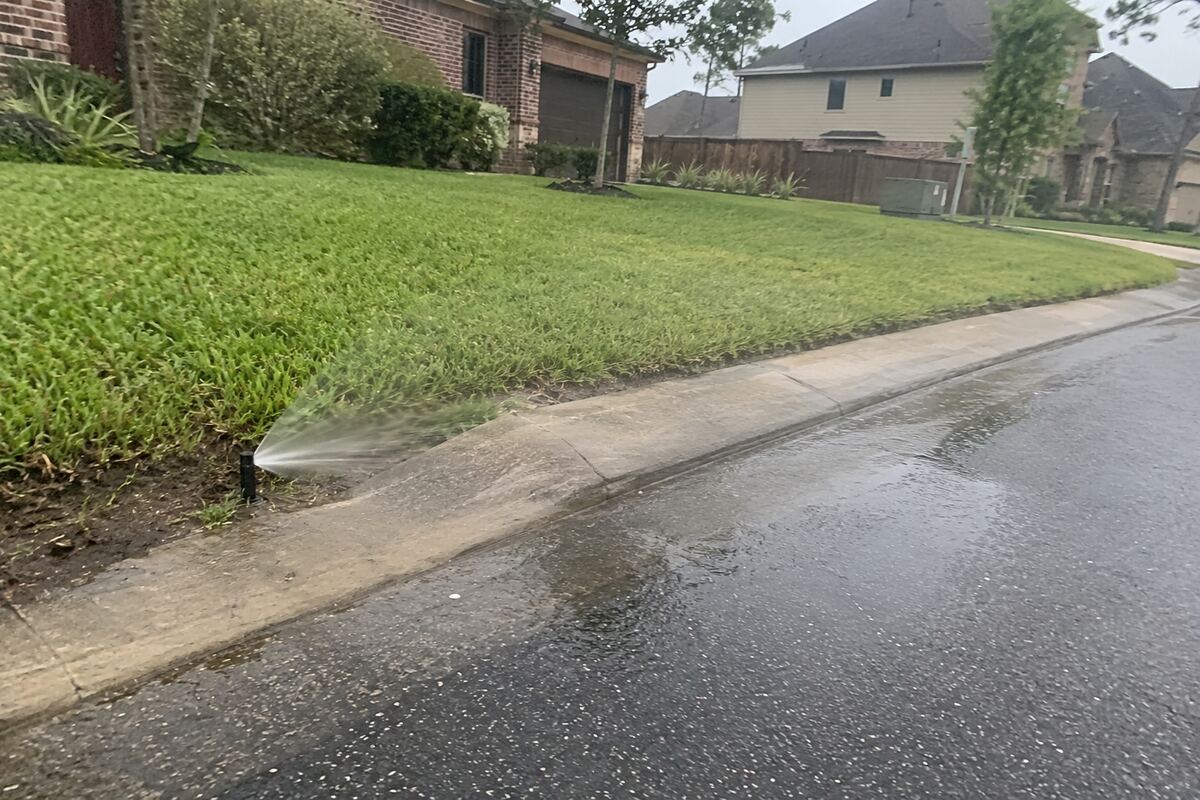
This is the local one. Beaumont clay shrinks through a Houston August and swells through a wet spring, and it does not do so evenly — the ground under a bed edge behaves differently from the ground under open turf ten feet away. A head that was set flush at installation ends up standing proud of the grade, tipped a few degrees off vertical, and now throws over the sidewalk instead of onto it. Nobody adjusted anything; the yard moved. The fix is resetting the head on a flexible swing joint rather than a rigid nipple, so the next season of movement bends something instead of breaking it.
Fixed spray nozzles are designed for roughly thirty psi at the nozzle. Municipal supply in parts of this metro arrives well above that, and the visible result is a fine fog rather than droplets: the pattern goes to mist, the mist drifts onto the driveway, and a meaningful share of the water never reaches the grass at all. The tell is that the whole zone looks hazy, not that one head is aimed wrong. Pressure-regulating head bodies solve it head by head; a pressure-reducing valve at the point of connection solves it for the entire system and is usually the better buy.
Two reasons beyond the neighbor. The first is that water landing on concrete is water billed and not used, and in a metro where a summer irrigation bill routinely runs into three figures a month, a zone fogging half its output onto a driveway is a measurable line item.
The second is regulatory. Water providers across the Houston area adopt drought contingency plans, and the stages in those plans commonly prohibit irrigation that runs off onto paving regardless of what day of the week it is. Which stage is in force, and what it forbids, is set by the individual utility or municipal utility district rather than by the metro — so the practical advice is to look up the provider named on the water bill rather than to assume Houston has one rule.
They should not be, and this is the single most common design fault found on retrofitted Houston systems. A fixed spray puts down water roughly three to four times faster than a gear rotor. Put them on one zone and any run time is simultaneously drowning the spray area and starving the rotor area. The fix is not a bigger nozzle; it is splitting the zone, which means a valve and pipe rather than a head.
That is a distribution question rather than a broken-part question, and it is answered by measurement rather than by eye — catch cans set out across the zone, run for a fixed time, then compare. Uniformity problems come from head spacing, mismatched nozzles, pressure loss at the far end of a long zone, or a partially clogged nozzle that still looks like it is working. The audit page covers what that pass involves.
Almost never. Weak lift across a whole zone is a pressure or flow problem upstream — too many heads on the zone, a partly closed isolation valve, a clogged filter at the backflow, or a mainline restriction. One head that will not lift while its neighbors do is usually grit under the riser seal or a wiper seal that has failed.
A decent pop-up body in this climate is a ten-to-fifteen-year part; nozzles clog and wear sooner, and the wiper seals go before the body does. What actually kills them here is mechanical: mower wheels, vehicles on the turf, and the ground moving under them. A head replaced on a swing joint tends to outlive one screwed onto a rigid nipple by years.
When the head snapped off at the fitting rather than simply turning.
Catch cans, uniformity and where the dry ring is actually coming from.
The permanent answer to a spray head aimed at a fence or a window.
What fogging, overspray and runoff cost across a Houston summer.
If it is one arc, adjust it and keep the money. If the whole zone hazes over or heads keep coming out of grade, that is a pressure or a soil problem worth having looked at.
Call (346) 605-8787 Describe the Problem Houston