It is the brass or bronze assembly standing above ground near the side of the house, usually with two test cocks and a pair of shutoff handles. It exists to stop lawn water — which has been sitting in pipe with fertiliser, dog waste and soil around every head — from being drawn backwards into the drinking water supply. It is the one part of a sprinkler system that is there for the neighborhood rather than for the lawn.
On a pressure vacuum breaker, the air inlet on top is supposed to open when pressure drops and close when the system pressurizes. A brief spit as a zone starts, that seals within a few seconds, is the assembly working. Most calls about this are calls about correct behavior, and saying so is cheaper for everyone than a truck roll.
That is a failure. The poppet or float in the air inlet is not seating — debris, a hardened seal disc, or a spring that has lost tension. On most residential assemblies this is a rebuild kit, not a replacement.
An O-ring or the bonnet gasket, if it is a seam. If the drip is coming from a hairline in the casting itself, that is not a seal and the assembly is finished — and in this metro the overwhelming reason a casting cracks is a freeze.
Test cocks are small ports for a gauge, and they should be closed and dry. A weeping test cock is usually just a loose or worn cock rather than an assembly failure, and it is the cheapest thing on this page to put right.
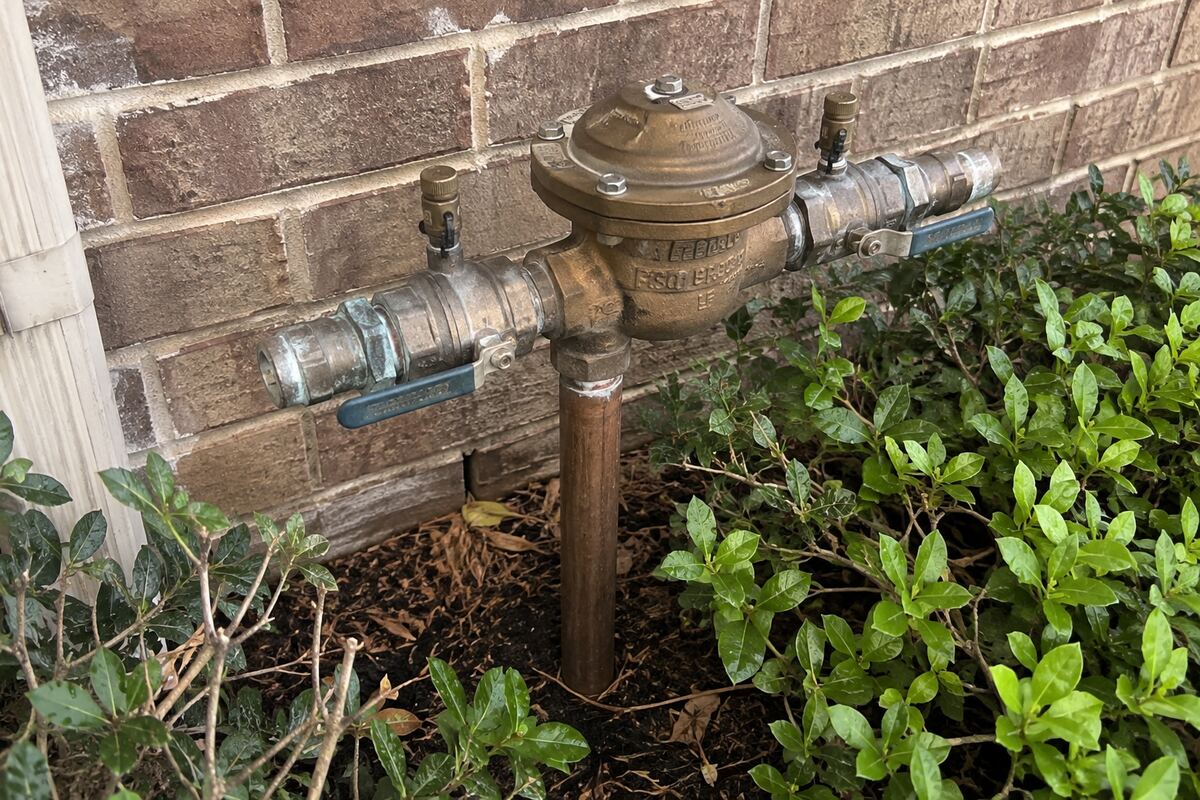
A pressure vacuum breaker only works if the atmosphere can reach it, and it has to sit above the highest sprinkler head on the system by a clear margin so that gravity cannot push water back through it. That is why it stands on a riser in the open instead of living in a box like everything else, and it is why it is the single most freeze-exposed component in a Houston irrigation system. Everything else is buried; this one is standing in the wind.
That exposure is the whole argument of the freeze section of this site, and it is worth reading before November rather than after a hard freeze — wrapping an assembly costs a few dollars and takes ten minutes, and replacing a cracked one does not.
Worth it when the casting is sound and the failure is a seal, a poppet, a spring or a check disc. Kits are made for the common residential assemblies and the parts are inexpensive. An assembly that is otherwise in good condition can take several rebuilds across its life.
Necessary when the body or bonnet is cracked, when the assembly is an obsolete model with no kit still made for it, or when repeated freezes have left it repaired more than once. Replacement is meaningfully more expensive than a rebuild, and it is the highest-ticket routine repair in residential irrigation — which is exactly why the freeze cluster exists.
Testable backflow assemblies are tested with a differential gauge by a tester holding the appropriate Texas license, and many water providers across this metro require that test on a set cycle and want the report filed with them. Whether the requirement applies to a particular property depends on the water provider named on the bill — a City of Houston address, a municipal utility district in Cypress and a city system in Sugar Land do not all impose the same schedule, and a page that told you they did would be wrong.
The practical version: find the provider on the water bill, ask whether an annual irrigation backflow test is required at that address, and if it is, ask the person doing the repair whether they also hold the tester license. Plenty do, and having both done in one visit saves a second call-out.
No, and this is the one place on this site where the answer is flat. Backflow prevention on an irrigation system connected to a potable supply is a requirement, not an upgrade, and the risk it addresses is a real one — a pressure drop on the street main during a fire flow or a water main break can pull water backwards out of a lawn system into the supply. Removing it is also the sort of thing a water provider notices at the next inspection.
In residential Houston, most often a pressure vacuum breaker: a single vertical body with a domed top, standing above ground. Double check valve assemblies sit lower and can be installed below grade in some configurations. Reduced pressure zone assemblies are the highest-protection type and have a visible relief port that discharges to the ground — those show up where chemicals can be injected into the system, and on commercial properties.
A brief discharge on start-up is normal behavior for a reduced pressure zone assembly. A continuous discharge is not — it means one of the two check valves is fouled or the relief valve itself is failing, and the assembly is doing its job by dumping rather than allowing backflow. It needs attention, but the failure mode is deliberately the safe one.
In the absence of freezes, a long time — the brass outlasts nearly everything else in the system, with periodic rebuilds. Freezes are what set the real lifespan in this metro. An unwrapped assembly that has been through several hard freezes is on borrowed time regardless of what the last test said.
The ten-minute job that prevents the most expensive repair on this site.
What the highest-ticket residential irrigation repair actually runs.
A continuously discharging assembly is metered water going to the ground.
Backflow, cross-connection and the vocabulary the regulations actually use.
Say whether it spits only at start-up or runs continuously, and whether the body looks cracked. Those two answers separate a rebuild from a replacement before anyone arrives.
Call (346) 605-8787 Describe the Problem Houston