The riser is the short vertical piece connecting the buried lateral pipe to the sprinkler head. When a mower wheel, a vehicle or a season of ground movement puts sideways load on a head, the riser is where it breaks — and it usually breaks below the surface, leaving a threaded stub locked inside the fitting and a zone that now fountains from a hole in the lawn.
A threaded PVC nipple is strong in tension and brittle in bending. Screwed directly into a tee, it makes the head a rigid lever with the fitting as the fulcrum: any lateral force has exactly one place to go, and the nipple has no capacity to absorb it. That is a workable design in stable soil. It is a poor one here.
Beaumont clay moves vertically through the year, and it does not move uniformly across a yard. Ground under a bed edge, under a driveway apron and under open turf all rise and fall on different schedules, so a lateral pipe and the head above it end up being pushed and dragged in slightly different directions across a season. Add a mower and the arithmetic is straightforward: rigid risers in this metro do not fail because someone was careless, they fail because they were always going to.
The same soil behavior is famous for what it does under a slab. That is a structural question with a structural answer and it is not this trade’s work; what belongs here is narrower and more mechanical. A rigid riser is a lever, the fitting is the fulcrum, and this ground supplies the force twice a year.
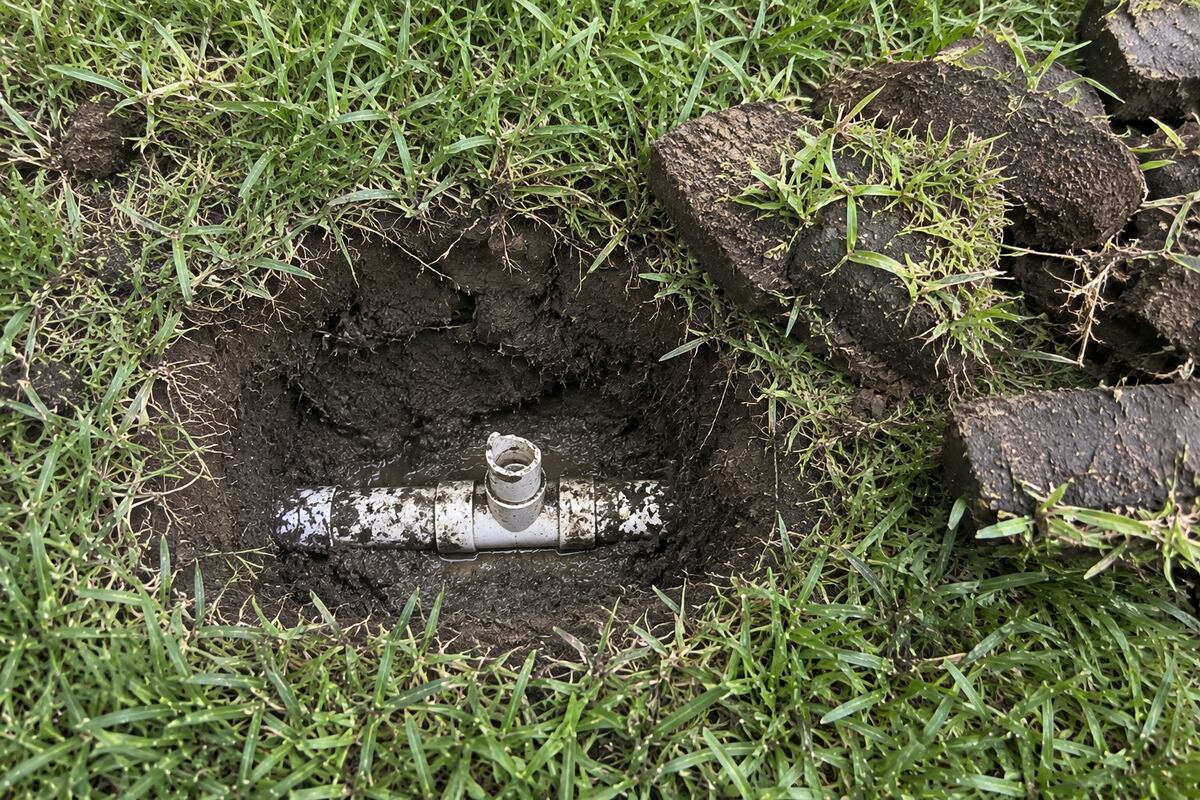
If enough of the stub stands proud, it comes out with pliers. If it snapped flush, an extractor tool bites the inside of the remaining thread and backs it out without damaging the female fitting. The wrong move is a screwdriver and a hammer — cracking the tee turns a fifteen-minute repair into a pipe repair, and on a solvent-welded lateral that means cutting, coupling and cure time.
A swing joint — three elbows and two short nipples, or a flexible poly assembly — lets the head move in every direction without loading the fitting. It costs a few dollars more than a rigid nipple and it is the difference between a repair that lasts and one that repeats. On any head that has broken once, this is the fix worth insisting on, because the position that broke it will not have changed.
Getting the head back to grade is the other half. A head set proud is the next one to be hit; a head set too deep floods its own body with soil and stops sealing. Flush with the turf, plumb, and on something that flexes.
Vehicles cut the corner, delivery trucks park half on the grass, and the soil at a paving edge moves differently from the soil ten feet in. Heads in that strip break repeatedly. Moving the head a foot inward, or switching that edge to a different head type set lower, is usually cheaper than the third repair.
Roots lift, edging shifts, and mulch gets topped up year after year until a head that was flush is now four inches below the surface and being hunted for with a spade. Bed heads are the strongest candidate for conversion to drip, which removes the head from the collision zone entirely.
The pivot point at the end of a mowing run takes a wheel loaded sideways. It is worth walking a yard once and noting where the turns happen, because those spots and the repeat-failure spots are usually the same list.
The straightforward version genuinely is: a stub that stands proud, a matching head, and a swing joint from any irrigation supplier. Where it stops being a homeowner job is when the tee cracks during extraction, when the lateral has to be cut into, or when the head needs digging out of a bed with the pipe location unknown. The honest line is that the first attempt is low risk; the second hour of it is not.
It can, and on a head that has never been hit there is no urgency. On a head that has broken once, reusing rigid pipe is repeating the experiment. The cost difference is a couple of dollars per head.
By design, in effect. The riser is the weakest point in that assembly and it is meant to be: a break at the riser is a fifteen-minute repair at the surface, while a break in the buried lateral is a trench. It is a small mercy that the sacrificial part is also the accessible one.
Usually not. Simultaneous riser failures across a yard point at something systemic — a pressure surge, a contractor working on the property, or a period of severe ground movement after a drought broke. Multiple failures at once are worth an audit rather than four separate repairs.
When the head is intact but pointed at the road, or fogging.
When the break is in the pipe rather than at the fitting.
Several heads and a zone lost at once, usually after work in the yard.
Taking bed heads out of the collision zone permanently.
One break is a repair. A pattern of breaks in the same places is a design problem worth fixing once. Say which it is and where the property is in the metro.
Call (346) 605-8787 Describe the Problem Houston