This is the one upgrade on this site that pays for itself on a Houston water bill rather than simply fixing something broken. It also solves three nuisances at once — overspray on fences and windows, heads getting broken in beds, and mulch washing out — and it is usually done zone by zone rather than all at once.
Beaumont clay has an infiltration rate measured in small fractions of an inch per hour. A fixed spray nozzle applies water at well over an inch an hour. The arithmetic is unforgiving: within a few minutes the soil surface has taken all it can, and everything after that either sits in a puddle, evaporates, or runs to the low point — which in a typical Houston front yard is the driveway, then the curb, then the storm drain.
Drip changes the application rate rather than the total. Inline dripline emitting under half a gallon per hour per emitter delivers water at roughly the rate clay can take it, at the root zone rather than on the leaves, under the mulch rather than on top of it. The same amount of water reaches the plants using considerably less at the meter, and it does it without a puddle.
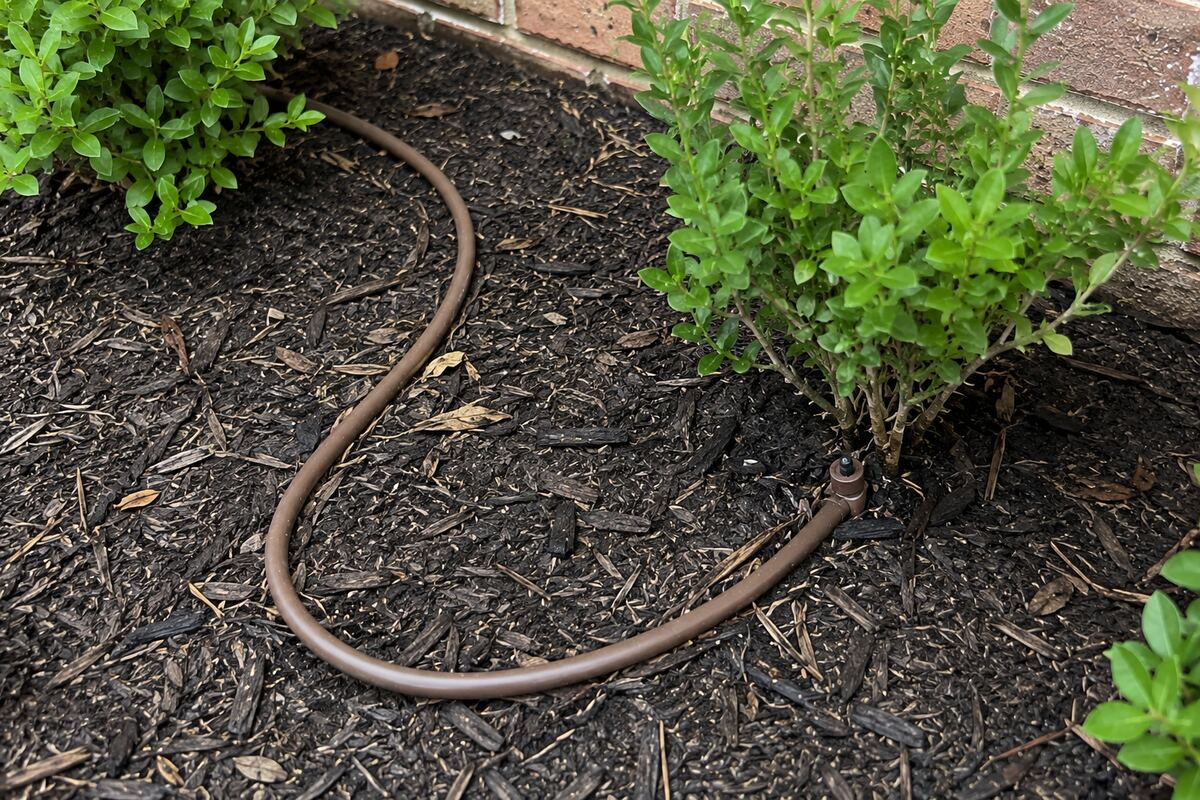
Drip runs at far lower pressure than spray — usually somewhere around twenty-five to thirty psi — and it clogs if debris reaches the emitters. So a conversion starts at the valve with a pressure regulator and a fine mesh filter. Skipping either is the single most common reason a drip retrofit fails within two seasons: unregulated pressure blows fittings off, and an unfiltered zone silts its emitters shut one by one.
Half-inch distribution tubing runs the length of the bed with either individual emitters at each plant or continuous inline dripline laid in loops. Individual emitters suit widely spaced shrubs; inline dripline suits dense planting and ground cover. Both go under the mulch, not on top, where they stay out of the sun and out of the way of a spade.
This is the step that gets forgotten. A drip zone needs far longer run times than the spray zone it replaced — often three or four times as long — because it is applying water much more slowly. Converting the hardware and leaving the schedule alone produces beds that are drier than before and a homeowner who concludes drip does not work.
Foundation beds, shrub borders, raised beds, tree rings, narrow strips beside a driveway or fence where spray inevitably hits paving, and any bed where heads keep getting broken. Anywhere the planting is permanent and the geometry is awkward, drip wins comfortably.
Open turf. St Augustine spreads by stolons across the whole surface and needs water across the whole surface; subsurface dripline for lawns exists and works, but it is a considerably larger installation than a bed retrofit and it is not a like-for-like swap for a spray zone. Anyone quoting a cheap drip conversion for a front lawn is describing something else.
One claim worth pushing back on before somebody else makes it: drip in foundation beds does keep soil moisture around a slab steadier through a drought, and that is a real effect. It is not a reason to buy drip, and anyone selling a bed conversion as foundation protection is overselling a side effect. Buy it because it waters beds better and wastes less; take the rest as a bonus.
Frequently, yes — many drought contingency plans in this region treat drip and hand watering differently from spray, on the grounds that they do not produce runoff. But the stages and the exemptions are set by each water provider or municipal utility district, not by the metro, so the answer for a specific address is on the water bill rather than on this page. It is a real and often significant benefit; it is just not a universal one.
Under mulch and out of sunlight, a long time — the enemy is UV exposure and physical damage from digging rather than age. Tubing left on top of the mulch, or exposed after mulch has washed out, embrittles noticeably faster. Emitters are the wear item, and they clog rather than wear out, which is what the filter is for.
No, for the same reason rotors and sprays should not share one: wildly different application rates on one run time means one half is always wrong. A conversion either takes the whole zone or splits the zone, and splitting means a valve.
On bed zones, usually and sometimes substantially, because most of what a spray zone loses on a clay bed is loss rather than use. The size of the saving depends on how much of the system is beds and how steep the provider's rate tiers are. It is a genuine efficiency change rather than a marketing one, but a house that is ninety per cent turf will see a small number.
The nuisance a bed conversion removes permanently.
Where the summer number actually comes from, tier by tier.
Heads in mulch, and why they keep needing digging out.
What a conversion runs, against what the zone currently spends.
A conversion is priced per zone, so it can start with the worst one. Say how many bed zones there are and where in the metro the property sits.
Call (346) 605-8787 Describe the Problem Houston