This one is time-sensitive in a way most irrigation faults are not. Everything between the water meter and the zone valves is mainline — it holds pressure continuously, whether or not any zone is scheduled. A failure there does not wait for the next cycle and does not stop when the cycle ends. It runs until somebody closes a valve.
Almost every Houston system has one, and it is almost always at or just below the backflow assembly — the brass or plastic unit standing above ground near the side of the house or the front bed. A quarter-turn ball valve handle in line with the pipe is open; across it is closed. This is the right shutoff because it leaves the house on water.
If the isolation valve cannot be found or will not turn, the next stop is the main shutoff for the property. That kills water to the house too, so it is the fallback rather than the first choice, but a yard filling with water is worth a cold shower.
Last resort. There is a utility-side valve in the meter box, usually needing a meter key rather than a hand. Some utilities take a dim view of customers operating it, so this is where a phone call to the water provider belongs rather than a wrench.
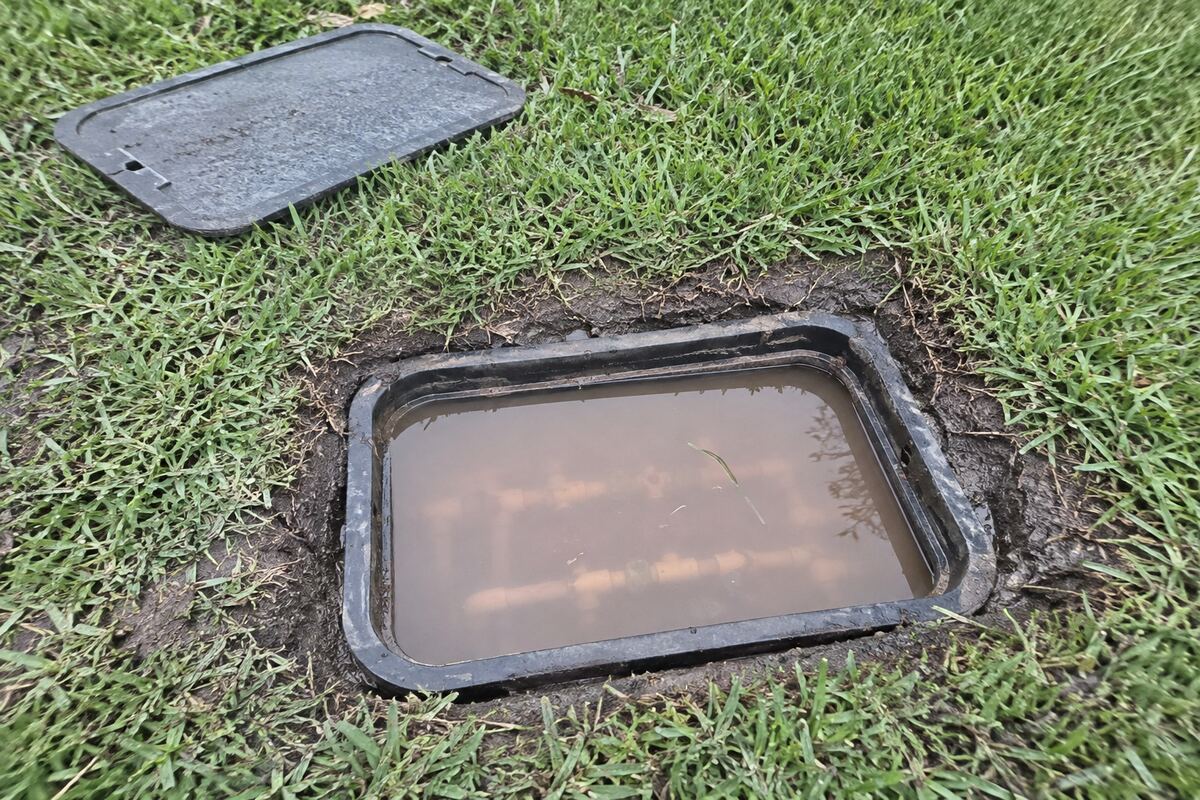
Plastic that has spent fifteen Houston summers at soil temperature goes brittle. The crack usually starts at the bonnet screws or at the threaded inlet. A freeze in a box that has filled with water does the same thing faster, which is why a geyser in late January and a geyser in July are often the same part failing for different reasons.
The diaphragm is the rubber sheet the valve uses to hold itself shut. When it tears, water finds the path of least resistance, which is out through the bonnet or straight past into the zone. A torn diaphragm can present as a geyser or as a zone that will not shut off — same part, two symptoms.
Where two or more valves share a common inlet manifold, the failure point is frequently a threaded adapter rather than the valve. Threaded PVC has a narrow window between under-tightened and over-stressed, and a joint that was cranked on with pipe wrenches at installation can split years later without any provocation.
A mainline break just upstream vents into the box because the box is the void. That distinction matters for the repair: the box gets excavated either way, but a mainline repair means cutting into a live pressurized line and waiting for solvent weld to cure before pressure goes back on.
A half-inch opening on a residential mainline at ordinary Houston street pressure moves water at a rate that turns into thousands of gallons over a weekend, and the meter counts every one of them. This is the single fastest way to get a four-figure water bill from a sprinkler system, which is why the first section of this page is about shutting it off rather than about diagnosis. Once the water is off, nothing is urgent any more and the repair can be scheduled properly.
If the bill has already arrived, most Houston-area utilities have some form of leak adjustment process, and every one of them requires evidence that the leak was repaired. Keep the invoice.
Then the leak is upstream of that valve — between the meter tap and the isolation point, or the isolation valve itself is not seating. Go to the house main. It also tells the irrigator something useful before they arrive: the failure is on the supply side of the backflow, which is a different repair and, on many systems, a different piece of pipe entirely.
Sometimes. If the crack is in the bonnet, a rebuild kit or a bonnet replacement handles it. If the body is split, the body has to come out of the manifold, and that means cutting PVC and rebuilding the joints, which is the part that turns a thirty-minute job into a half-day one. Solvent-welded PVC also needs a genuinely dry joint and a cure time before pressure returns — that is why a repair on a rainy Houston afternoon sometimes gets scheduled for the next morning rather than rushed.
Because it is a box in clay soil with no drainage. A valve box that stands full of water is the reason valves crack in a freeze and the reason wire splices corrode. A layer of gravel under the valves and a box set at the right height fix it permanently, and it is worth asking for while the hole is already open.
It is urgent rather than dangerous. Nothing about it threatens the house directly unless the water is running toward the slab or into a garage. The cost is the meter, and that clock only stops when the isolation valve closes — so shut it off, then treat the repair as a normal scheduled call.
Mainline against lateral, and why the two are repaired differently.
Reading the meter to prove what is running when nothing is scheduled.
The pressure spike that cracks the fittings this page is about.
The January version of a cracked valve body, one step up the system.
Once the isolation valve is closed nothing is on a clock. Say what part of Houston the property is in and what the box looked like, and a licensed irrigator covering that area can take it from there.
Call (346) 605-8787 Describe the Problem Houston