Water hammer is the sound of momentum stopping. A column of water moving through the mainline has real mass; when a solenoid valve slams shut in a fraction of a second, that column has nowhere to go and its energy turns into a pressure spike that can briefly reach several times the static pressure in the pipe. The bang is the symptom. The spike is the problem, and it is the reason fittings on a noisy system fail years earlier than fittings on a quiet one.
Supply pressure across this metro is not uniform — it depends on the provider, the elevation of the nearest storage, and how far down the distribution main a property sits. Plenty of neighborhoods see static pressure comfortably above what a residential irrigation system was designed around. The spike scales with the static pressure it starts from, so a high-pressure address gets a harder hit from the same valve.
The rule of thumb the trade works to is that water in a mainline should stay under about five feet per second. Push more flow through the same pipe and the velocity climbs, and hammer intensity climbs with it. A system that had four zones added to it over twenty years without the mainline ever being resized is the classic Houston case — each addition was reasonable on its own and the cumulative result is a pipe running well over its design velocity.
The third condition is valve closing speed, and that one is not regional — it is simply what a diaphragm valve does when its flow control is wide open.
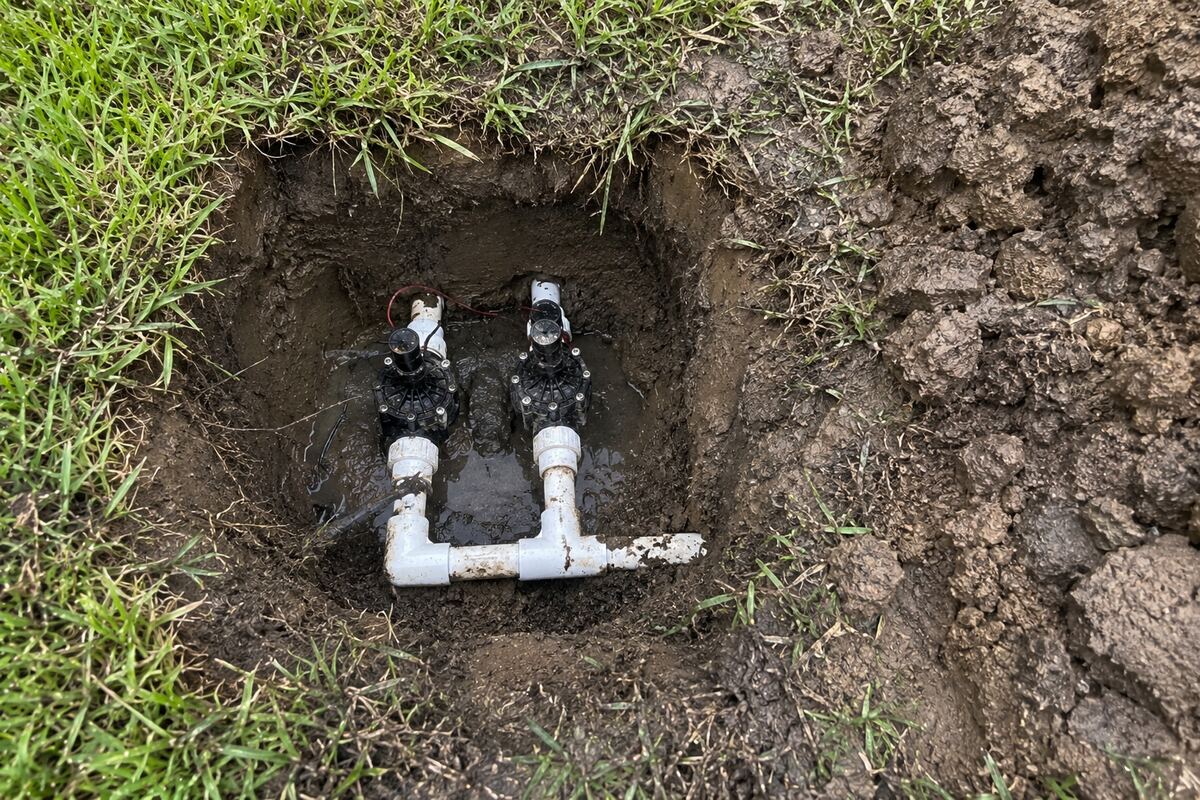
Most residential zone valves have a flow-control stem on the bonnet. Turning it down slows how fast the diaphragm can seat, which flattens the spike. Free, reversible, and often enough on its own — but it is a per-valve adjustment that has to be balanced against the zone still getting the flow it needs.
A pressure-reducing valve fitted after the backflow assembly holds the whole system at a sane operating pressure regardless of what the street does. It fixes hammer, fogging nozzles and premature seal wear in one part, which is why it is usually the best value on this list even though it is not the cheapest.
A mainline that drains down and refills — after a repair, after a winter shutdown, after the isolation valve has been closed — carries air pockets that make the first cycle bang like a drum. Opening the isolation valve slowly on start-up rather than snapping it open is half the answer; the other half is making sure the system has somewhere for that air to leave.
The fourth is structural: an undersized or unsecured mainline. Resizing pipe is real excavation and rarely worth doing for noise alone — but if a system is already being opened up for a break repair, it is the moment to ask whether the pipe is the right diameter for the flow it now carries.
A system that bangs is a system whose joints are being fatigue-loaded twice a night through an irrigation season. Threaded PVC adapters and solvent-welded socket joints are the parts that give first, and they give at the manifold, where there are the most of them. So a house with audible hammer and a house with a mainline break next spring are frequently the same house, and the connection is rarely made because the two events are months apart.
That is the argument for treating the noise as a repair rather than a quirk: the cost of a flow-control adjustment or a pressure-reducing valve is a small fraction of the cost of excavating a manifold, and it buys back years of fitting life.
It can be. The irrigation mainline is tapped off the same service line that feeds the house, and a pressure spike travels back through it. If the bang happens at the same minute every night and stops when the controller is switched off for a day, the sprinklers are the source regardless of where it is audible.
A water hammer arrestor is a sealed air chamber that absorbs the spike, and it is standard on quick-closing appliance valves indoors. On an irrigation system it can help, but it treats the symptom at one point while the pressure and velocity that caused the spike remain. Where static pressure is genuinely high, regulating pressure does more for the system as a whole than absorbing the shock at one fitting.
Usually it is more noticeable in summer because the system runs more often, and it can be genuinely worse when the utility raises pressure to meet peak demand. It is also worse right after any repair, because the line has been drained and refilled with air in it.
Physically it is a stem on top of the valve turned with a screwdriver or by hand. The judgement is the hard part: turned down too far, the zone loses the flow it needs and heads stop lifting properly, which is a coverage problem that shows up as brown grass a fortnight later rather than as an obvious fault. Adjusting one valve to see if the noise changes is reasonable; balancing every valve on a system is a job worth handing over.
The failure that repeated pressure spikes are quietly working toward.
Where the fittings actually let go, and how to stop the water.
The other visible symptom of the same excess pressure.
A pressure-reducing valve against a manifold excavation, side by side.
Worth a look before it becomes a dig. Say roughly where in the metro the property is and when the noise happens, and a licensed irrigator covering that area can take it from there.
Call (346) 605-8787 Describe the Problem Houston