In a metro that takes roughly fifty inches of rain a year, mostly in short heavy events, a system with no working rain shutoff waters the lawn during the storm and again the following morning. It is the most visible waste an irrigation system produces, it is the thing neighbors notice, and the part responsible for it usually costs less than a tank of fuel.
Texas irrigation rules require that a new irrigation system be installed with a rain or moisture shut-off device. That is a design requirement on the installation, not an ongoing inspection regime — nobody comes back to check that it still works. So on any system installed in the last couple of decades the sensor is meant to be there, and the practical question is whether it is still doing anything.
Three states it can be in, and only one of them is a fault worth a part:
Most controllers have a physical sensor bypass switch, and a lot of them have been flipped to bypass at some point by someone troubleshooting something else and never flipped back. Free to fix and worth checking first.
A sensor mounted on the eave with its wire terminating nowhere, or a controller with a jumper still fitted across the sensor terminals from the factory. The jumper is what makes a controller work without a sensor attached; leaving it in place while mounting a sensor produces a system that looks compliant and behaves as though the sensor does not exist.
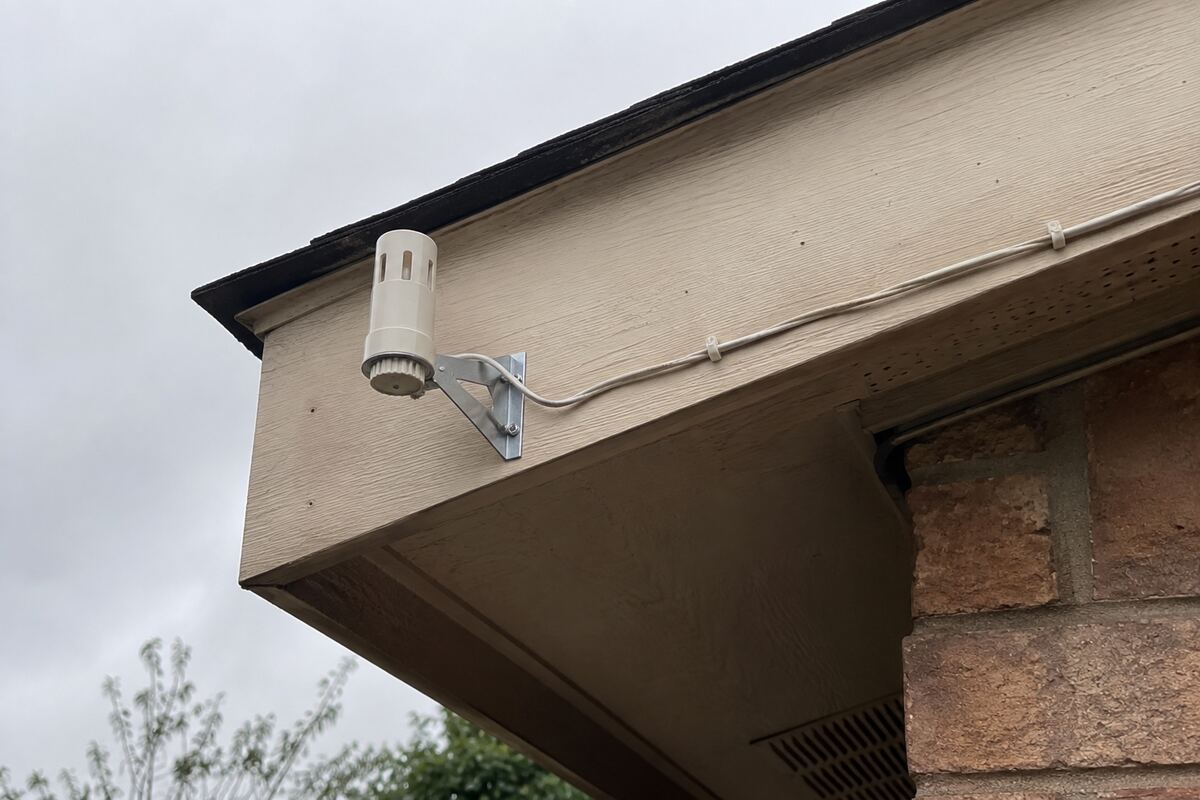
A stack of hygroscopic discs inside a vented cup swells as it absorbs rain and, at a set point, opens a switch wired in series with the controller’s common. The controller keeps counting but no valve energizes. As the discs dry out, the switch closes again. It is elegantly simple and it fails in two predictable ways: discs that have gone permanently swollen after years of Gulf Coast humidity, so the system never waters, and a vent that has filled with dust, pollen and wasp nest so the discs never get wet and the system always waters.
It has to see the same rain the lawn sees. Under a deep eave, under a tree canopy, or on a wall sheltered from the prevailing direction, it sees a fraction of the rainfall and behaves accordingly. It also has to be somewhere reachable, because a sensor at the peak of a two-story roof will never be cleaned or replaced. Most bad sensor behavior in this metro is a mounting decision rather than a defective part.
Some sensors combine rain shutoff with a freeze cut-out that stops the system below a set temperature. That is genuinely useful in Houston — irrigation running onto a road on a freezing night is a hazard as well as a waste — but it is worth being clear about what it protects. A freeze sensor stops the system watering during a freeze. It does nothing whatsoever to protect the backflow assembly standing above ground, which is the component that actually cracks and the most expensive part to replace.
Those are two different problems with two different answers, and conflating them is a common and costly assumption. The freeze section covers the one the sensor cannot help with.
Partly. A weather-based controller pulls forecast and observed data for a nearby station and skips accordingly, which is genuinely effective for widespread frontal rain. Houston’s summer rain is often convective and highly localized — two inches on one subdivision and nothing four miles away — and a station-based forecast handles that poorly. An on-site sensor measures what actually landed on that roof. The two together are better than either.
Expanding-disc units in this climate are commonly a five-to-ten-year part, and they tend to fail quietly rather than obviously. The cheap test is to soak the discs with a hose while a zone is running and see whether the system shuts down within a minute or two. If nothing happens, the sensor, the wiring or the bypass switch is the answer.
Wireless removes the wire run, which on a two-story house or a retrofit is most of the labor. The trade is a battery to replace and a radio link that can be lost without any visible sign. Neither type is clearly better; the wire run is what usually decides it.
No, and this is worth separating. A sensor stops the system watering while it is raining. Drought stage restrictions set by a water provider control which days and hours the system may run at all, and those are enforced against the property owner regardless of what hardware is fitted. The provider named on the water bill is the authority on which stage applies.
Bypass switches, jumpers and the schedule the sensor is overriding.
What a freeze sensor does not cover, and what actually cracks.
What watering through a wet fortnight costs on a rising block rate.
Where the sensor test belongs in a full pass over the system.
Both symptoms come from the same part and the same three wires. Say which one it is and where the property sits in the metro.
Call (346) 605-8787 Describe the Problem Houston