A controller that lights up but never waters is a different fault from a controller that is dead. Both get called “the timer is broken,” and in a lot of cases neither one is — the box is doing exactly what something else told it to.
Most Houston controllers plug into a garage or utility-room receptacle on a GFCI circuit shared with the washer, a freezer or an outdoor outlet. Something else on that circuit trips it, nobody notices for a fortnight, and the lawn browns out. Look at the controller’s own display before assuming anything — blank means power.
A sensor wired in series with the common tells the controller to skip. An expanding-disc sensor that has swollen and never dried out, or one that has physically failed open, produces a permanent skip. Most units have a bypass switch on the controller face; flipping it to bypass for one manual test settles the question immediately.
Water budget, seasonal adjust, percentage adjust — the same dial under different names. Somebody sets it to 0% during a wet November and never sets it back. Every station then runs for zero minutes, which the controller reports as a completed cycle.
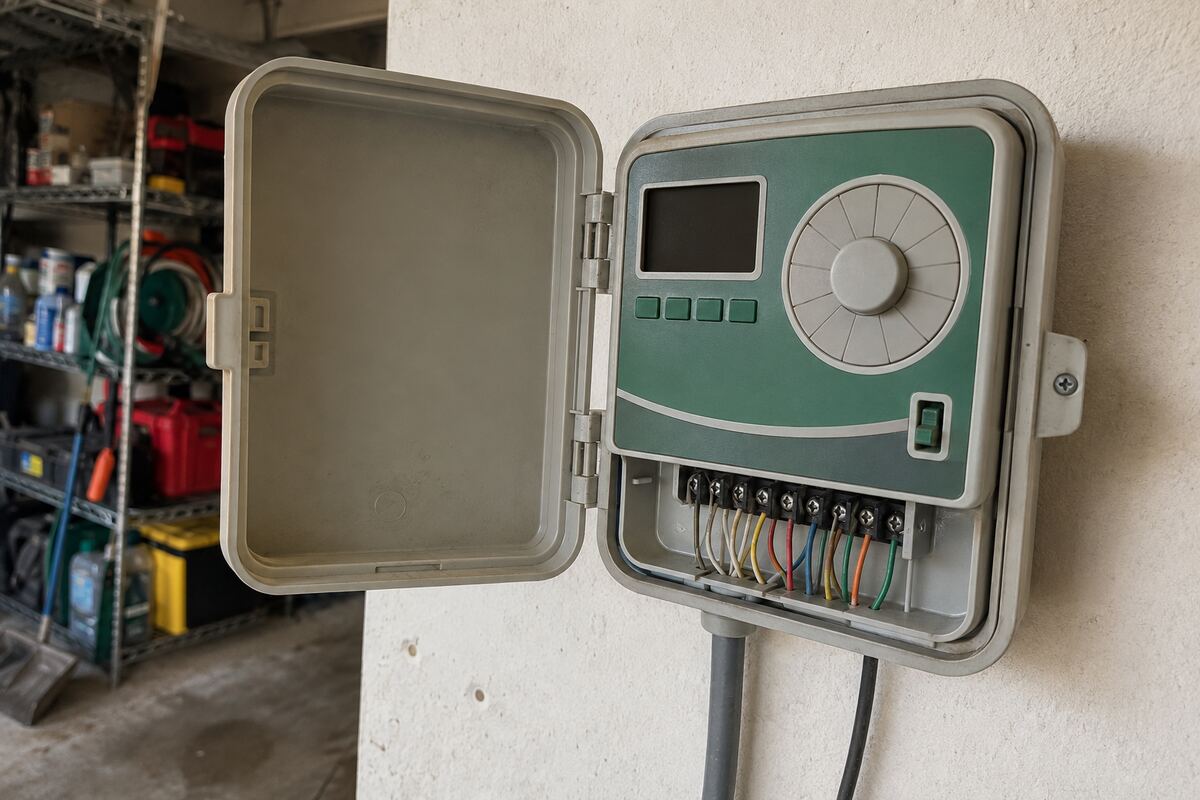
Two failures genuinely belong to the box. The first is the transformer or internal fuse — the unit is dark, or it powers up and then drops out the moment a valve is energized. The second is a failed station output, which shows up as one specific station that produces no voltage while the others measure a healthy twenty-four volts or so at the terminal strip.
Surge is the reason a lot of them fail here. The Gulf Coast runs one of the higher lightning-flash densities in the country, and an irrigation controller is unusually exposed: it is connected to household power on one side and to a hundred feet or more of buried copper on the other, which makes a decent antenna. A surge does not have to strike the house. It gets in through the field wiring and takes out the output stage, sometimes on one station and sometimes on all of them.
A transformer or a plug-in fuse is worth replacing on almost any controller. A blown station output on a fifteen-year-old unit usually is not — the part is not sold separately, and the practical answer is a new controller with the field wires moved across, which is an hour of labor and no trenching.
Beyond the schedule, two things worth having in this climate: a controller that senses zone current and reports an open or shorted station, and one that will hold its program through a power cut without a battery to forget about. Weather-based adjustment is a genuine water saver in a metro that swings from drought to fifty inches of rain, but only if somebody sets the soil type to clay rather than leaving it on the default.
It can be, for one specific reason that has nothing to do with the app. Houston clay accepts water at a fraction of an inch per hour, so a single long run time mostly runs off into the street. Controllers that support cycle-and-soak — splitting a fifteen-minute zone into three five-minute passes with a soak between — put noticeably more of that water into the root zone. That feature matters more here than the weather forecasting does.
Not necessarily. Older units keep the schedule in volatile memory backed by a 9-volt or coin cell, and once that cell dies the program is lost at the next outage while the controller itself works perfectly. Newer units store the program in non-volatile memory and only lose the clock. Reprogram it, note whether it holds through the next outage, and judge from that.
In most cases yes. The field wires terminate on a numbered strip, and a replacement of equal or greater station count takes them across as they are. The work turns into more than that when the existing wire count is short and zones have been doubled up, when the common is corroded at the controller end, or when the old unit was hard-wired rather than plugged in.
Texas irrigation rules require new systems to be installed with a rain or moisture shut-off device, so on any system of recent vintage the answer is that it is meant to be there and working. On an older system it may never have had one. Either way, leaving a failed sensor permanently bypassed to make the system run is treating the symptom.
Everything else runs. That is a valve, a solenoid or a splice, not the timer.
Where it should be mounted, and what a failed disc does to a schedule.
A controller running a zone twice a night is a common and invisible cause.
Schedule, pressure, arcs and coverage checked together rather than in isolation.
Describe what the display shows and whether any zone will start manually. Getting connected with a licensed irrigator in your part of Houston takes one call.
Call (346) 605-8787 Describe the Problem Houston